
In recent months, we have repeatedly heard and seen reports and images from Lebanon in the news. A massive explosion in the port area of Beirut has transformed large parts of the city into a field of rubble – much like in a war zone. Conspiracy theories are now circulating online claiming that Israel caused the explosion with missiles. But this isn't surprising, given the long-standing hostility between these two countries.
Furthermore, Lebanon is a country that hosts the most refugees worldwide (per capita), even though its area is only the size of the German state of Lower Saxony.
In the Molbergen congregation, we have a man from Syria who converted to Christianity in Beirut and later immigrated to Germany. Today he is a member of the congregation and a zealous evangelist among his fellow countrymen. Through his connection to the Kurdish community in Beirut, it was possible to organize a joint aid mission with fellow believers in that country.
We traveled to Lebanon with Nikolai Wall, the head of the Stephanus Relief Organization, to see where help is needed and how we can support the suffering population. What we saw deeply affected us. Even two months after the explosion, a large part of the city around the port still looks like a war zone. Within a radius of up to five kilometers, windows in apartments have been ripped out and smashed.

Destruction at the port after the explosion
Containers are still piled high in the port area, and large heaps of rubble clearly show the extent of the destruction. People cannot expect any help from the government, so everyone has to figure out how to repair their apartments, houses, etc., on their own. As a result, people are still living in homes without doors or windows, waiting for help from somewhere. The country is currently leaderless, but Hezbollah is trying to seize control.
In the first two days after our arrival, we met with local Christians to get a sense of the situation. We went to the port and saw the devastation the explosion had caused in the area. Afterwards, we visited several families living nearby who were also affected by the disaster. They are still missing window panes, and some children continue to suffer from sleep disturbances due to the loud explosion and the resulting destruction, bearing the scars of the trauma.

Many people died after the explosion on this street.
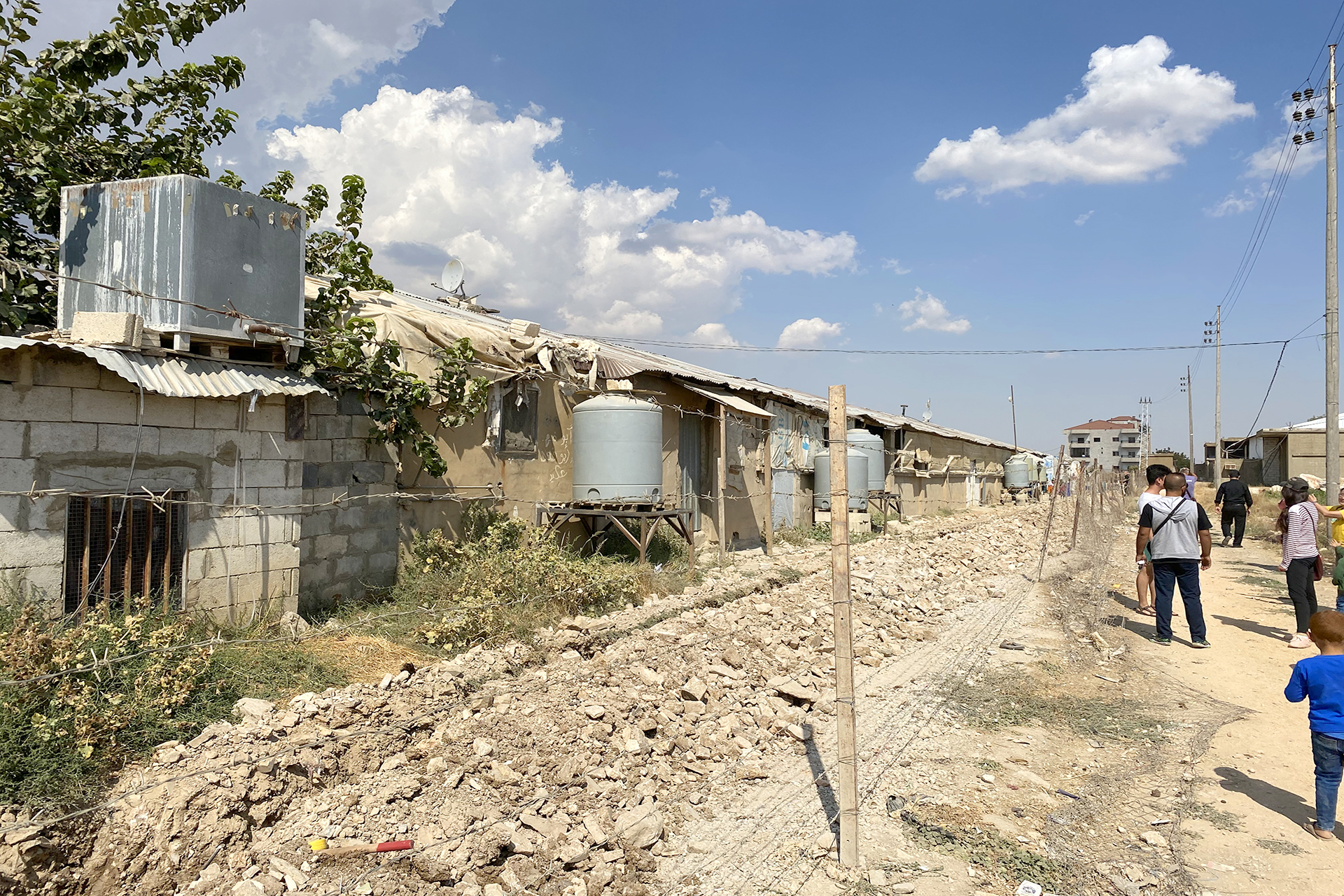
We also visited refugee camps and were able to see for ourselves how people are received as refugees in this country. In two of the camps, we saw chicken coops that had been converted into refugee shelters. A long coop was cleared out, partitions were installed, and 30 families were housed in it. The people live in very unsanitary conditions and are mostly cared for by UN refugee organizations or Christians.
But the worst thing for these people is their hopeless situation and lack of prospects. The children have no school, and families don't know where to go. They can't return to Syria because of the war. No one in the country or anywhere else in the world wants them. So they live from day to day, and no one really knows what the future holds.

Children in tent dwellings of a refugee camp
In this region, we had the privilege of meeting a small woman with a big mission. A woman from China came to Lebanon and cares for these refugees. She has established a school in five such refugee camps. Up to 80 children learn English and Arabic in a small room (the refugees are often Kurds who don't understand Arabic) using a Bible. The children memorize Bible verses and listen to biblical stories—in the hope that the word of God will transform their lives and bear fruit.
This courageous woman ran a school in another camp. However, the authorities didn't want her using the Bible as a textbook. So she closed the school because it was important to her that the children hear the word of God.

Distribution of aid supplies in the refugee camp
After all the distressing images, we got to work and went shopping with the siblings. We were able to pack hundreds of food parcels and distribute them to people in need. The siblings also asked us for warm clothing for the winter months. In December, January, and February, it often gets noticeably cold in this country, and people don't have heating in their homes. Therefore, they can only protect themselves against the winter cold with warm clothing and blankets. There is often snow in the mountains, and even in the coastal regions, the inhabitants of the country feel the winter acutely.
The pastor of the small Kurdish community asked us to pray for a vehicle during our travels so they could better carry out their ministry in the region. He has been praying for a vehicle for a long time and hopes that one day they will be able to buy one. In fact, the congregation had arranged a rental car for the entire week we were there, and they still had to hire a taxi or van at times to transport the packages and clothing we had purchased. No one in the community owns a car, so transportation was a constant challenge for us.

Vehicle for the Kurdish community - financed by the Stephanus Mission
After assessing the situation, we knew what we had to do. Thankfully, we had enough funds with us to provide this community with a vehicle: a seven-seater with enough trunk space to transport luggage and suitcases.
All in all, it was an unusual journey for us, not least because we were traveling in an Arab country with its unfamiliar culture. But God loves the Kurds and wants the Islamic world to hear the Gospel of God's grace and love, and for many people to be saved. The people of the Islamic world, too, are deceived by their religion and do not know the truth. Let us work while it is day. Night is coming, when no one can work.
Ernst Fischer
Municipality of Cloppenburg


