

Podcast: Download (Duration: 15:20 — 10.5MB)
Isn't it a contradiction in terms that a man who committed adultery and murder is described as a man after God's own heart? This man committed grave offenses. Yet even Jesus, the Son of God, allows himself to be called the son of this man (cf. Mark 10:46-52). This refers to David, who went through various stages in his life, with highs and lows that seemed to contradict each other.
David led an eventful life, for under his rule began the golden age of Israel. He was a gifted leader, hero, warrior, organizer, musician, and poet. Even in his youth, he was described as handsome, eloquent, capable, reliable, musical, and brave (cf. 1 Samuel 16:12, 18). His name “David” (Hebrew דָּוִד and דָּוִיד Dāwīd) likely means, among other things , “beloved.” Before David could even consider ruling as king, he had already been chosen by God (cf. 1 Samuel 13:14). Considering the meaning of his name, it seems as if God chose David even in his mother’s womb and ensured that he received the right name, meaning “beloved.”
Anointing
God sent the prophet Samuel to anoint David as king. From that day on, the Spirit of the Lord came upon David (see 1 Samuel 16:13). But instead of immediately accepting his kingship, David experienced much opposition and hardship. As soon as the Philistines gathered their armies for battle, David's eldest brother accused him of being arrogant and wicked, and of only wanting to watch the battle as a spectator (see 1 Samuel 17:28).
But David proved his courage, his integrity, and his faith in God. He was the one who had the courage to fight the giant Goliath. With God's help, this giant was defeated. After the victory over Goliath, Saul summoned David to the royal court (see 1 Samuel 18:2). From then on, David went to war for King Saul and risked his life for him, even though he himself had been anointed king. He submitted to the current king and anointed one, thus demonstrating his humility.
Contradiction and upheaval
David had a military career under King Saul. After only a short time, he rose above the other warriors. His bravery and successes against the Philistines distinguished him. Wherever King Saul sent David to wage war, he carried it out successfully (see 1 Samuel 18:5). The people revered him. But this did not last long. Instead of being pleased, King Saul became envious of David, angry, and plotted to kill him. David's fame overshadowed Saul's. He feared that David might become the next king (see 1 Samuel 18:1-30).
Thus began years of relentless persecution for David. It was a time of contradiction and upheaval in David's life. David repeatedly escaped King Saul. Even while fleeing, he refused to kill his pursuer, King Saul (see 1 Samuel 24). Although David thereby demonstrated his respect and loyalty to Saul, Saul continued to pursue him. God gave David another opportunity to kill Saul, yet he did not do it a second time (see 1 Samuel 26).
He was given the opportunity to escape his persecutor, exact revenge, and seize the kingdom. But despite the persecution, he demonstrated his sincerity and loyalty to the anointed and divinely appointed king. God gave him the foresight and wisdom not to commit this terrible act. Had David killed Saul, Saul's successor would have had to persecute him to atone for the murder (see Exodus 21:12-14). This would most likely have been his close friend and Saul's eldest son, Jonathan.
God's promise seems to contradict itself.
It seemed as if God's promises and His guidance contradicted each other. David had reason to despair. Instead of the promised kingship, David had to flee with 600 men to the Philistines. He fled to the enemies of Israel, whom he himself had fought. He was aware that Saul would one day have him killed. In an impending battle between the Philistines and the Israelites, David was to fight on the side of the Philistines against the land of Israel. He lied to the Philistine Achish, in whose service he now stood, about the locations of his raids. To prevent the deception from being discovered, he murdered mercilessly. In doing so, he gained the Philistine's trust (see 1 Samuel 27).
He then wanted to take David and his men with him into battle against Israel. However, David was spared from having to fight against Israel (see 1 Samuel 29:1-7). Upon returning to their home in Ziklag, he and his men discovered that the town had been looted and destroyed. David and his men had lost everything; all the women and children had also been taken away.
Out of bitterness, his own men wanted to stone him. But David took strength in the Lord, consulted Him, and received an answer. Then David and his men pursued the robbers and rescued everything that had been stolen, including all the women and children. God granted David a great victory. From the plunder they took, they were even able to give gifts to David's friends in Judah (see 1 Samuel 30). The apparent contradiction was resolved. Shortly afterward, King Saul was killed in battle, and David was anointed king in Judah (see 2 Samuel 2:4). Nevertheless, it still took more than seven years before David became king over all Israel (see 2 Samuel 5:5).
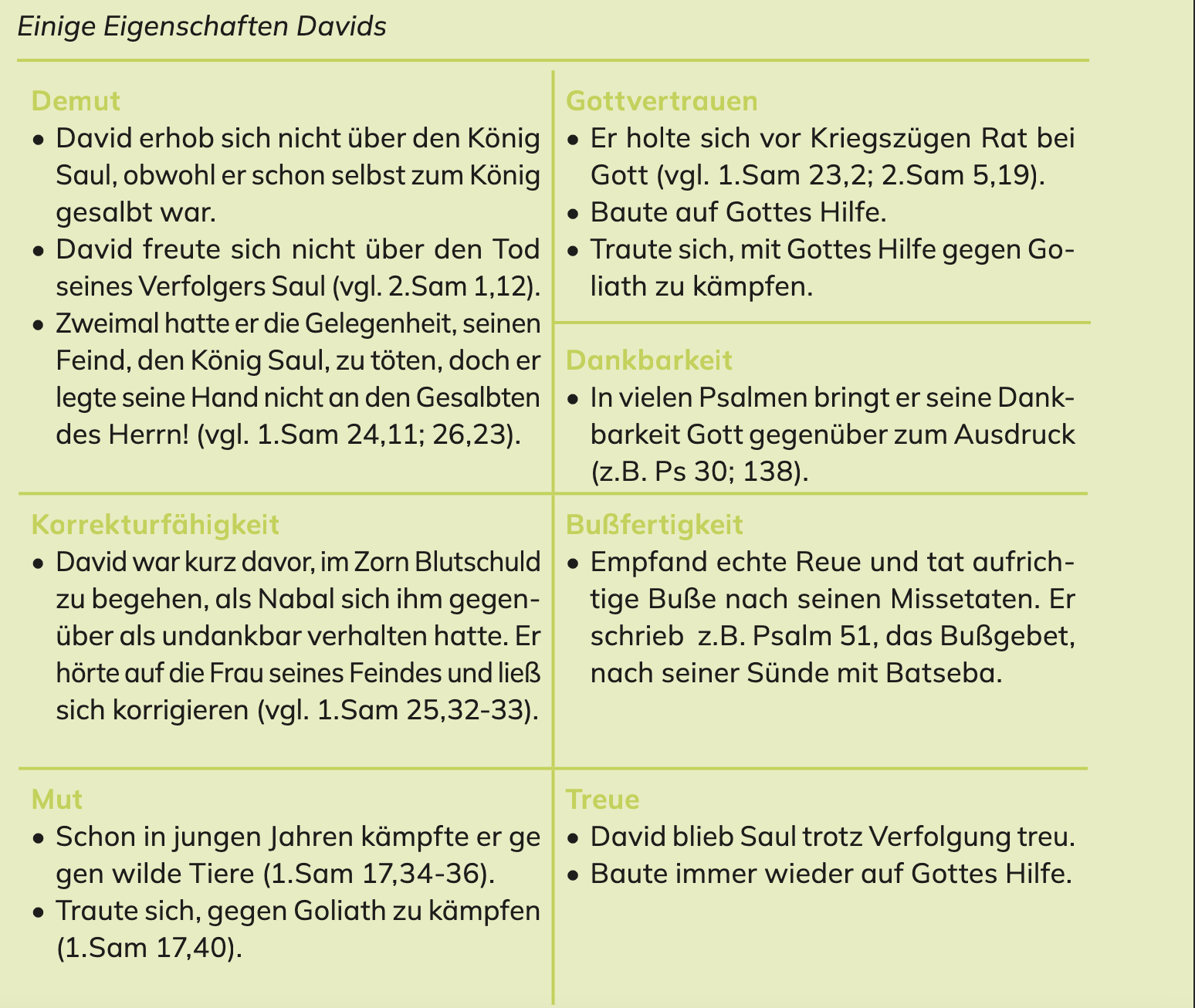
Some of David's characteristics
Fear of the Lord
David often found himself in perilous and seemingly hopeless situations. He couldn't understand why so much happened in his life and felt forgotten and abandoned by God. Many psalms bear witness to this (cf. Psalm 22:2). It's not always clear when he composed which psalm. However, David described many difficult life situations in his psalms. He brought his suffering, his despair, his lament, and his failings to God (cf. Psalms 13, 22, 38, 57).
In these psalms, he openly expressed his feelings before God. Despite the difficult situations, events, and moments in his life, he placed his trust in the Lord. David feared the Lord and allowed himself to be guided by Him. He knew that God holds everything in His hands and possesses all power.
Preparation
Even in his early years, David learned to place his trust in God. He was fortunate enough to have faith and trust in the Lord instilled in him from infancy. In Psalm 22:11, he says, "From the womb I was cast upon you; from my mother's womb you have been my God." In his mother's womb, he had experienced affection, love, comfort, and security. He learned even then that his life was in God's hands. He could remember this in times of need and glorify God.
Many men have become kings, but few truly were. Many kings abused their power, concerned only with their own well-being. They cherished luxury and their authority. David was different. He did not strive for power, even though he had the opportunity to take a step closer to kingship by murdering Saul. The life path he had to endure before becoming king shaped him. He gained experience along the way. He learned to renounce his power and relinquish his authority, including by fleeing to his enemies.
God prepared David for his role as king in this way. Through his life's circumstances, he learned to "be still" (Psalm 62:6), to "pour out his heart before God," and to "find his confidence" in God (Psalm 62:9). Through his courage, sincerity, and bravery, he also gained the people's approval. This preparation, experience, and recognition enabled him to serve as a good king.
A man with distinction
King David transformed the small nation of Israel into a powerful kingdom. He subdued many peoples: the Philistines, the Moabites, the king of Zobah, the Arameans of Damascus, and the Edomites (cf. 2 Samuel 8:1-13). Yet his greatest distinction and glory was that he was called a man after God's own heart, even though he committed terrible crimes during his life (cf. 1 Samuel 13:14). Because he shed much blood, he was not permitted to build a house for the Lord (cf. 1 Chronicles 22:8). He committed adultery (cf. 2 Samuel 11:4), and to conceal this, he then committed murder (cf. 2 Samuel 11:5-17).
He was not perfect and his transgressions displeased God, yet he had a repentant heart. He was willing to acknowledge his sins, humble himself, and repent before God.
David strove for righteousness and the will of God. Such are the people God seeks (cf. Jer 5:1). In retrospect, God spoke of David, saying that he had walked in a way pleasing to God (cf. 1 Kings 11:33). In the Epistle to the Hebrews, he is mentioned as the only king recognized as a hero of faith. This is because all later kings were judged by his example (cf. 1 Kings 14: 8 ).
In the Epistle to the Hebrews, two verses apply very strongly to David: Through faith he conquered kingdoms, practiced righteousness, obtained promises, silenced lions' mouths, escaped the edge of the sword, grew strong out of weakness, became mighty in battle, and routed foreign armies. Strengthened and fortified by his experiences, David walked throughout his life as a man after God's own heart (cf. Hebrews 11:33-34).
Peter aptly describes it in the New Testament: “The Lord knows how to rescue the godly from temptation, but to hold the unrighteous for the day of judgment, when they will be punished” (2 Peter 2:9). David feared God. Therefore, God stood by him, helped him, and saved him in his time of need.

David's highs and lows
Closing remarks
We can learn a great deal for our own lives from the events and stories of David. In the Bible, he is portrayed as a human being with strengths and weaknesses. Despite difficulties and seemingly unfulfilled promises from God, he trusted God completely. For God keeps his promises, even if it takes time! Isn't it sometimes the same for us? God has made so many wonderful promises to us through his Word, promises we can trust and hope in.
But sometimes it seems as if God doesn't keep His promises. Just as with David, He wants us to wait patiently. He wants to use this time to shape us, prepare us, and allow us to gather experiences for the next stage of our lives.
Anatoli Bloch
Municipality of Bielefeld