

Podcast: Download (Duration: 7:38 — 5.2MB)
Mission trip to Rwanda
In mid-September, a group of 10 people from the municipalities of Papenburg, Michelstadt, and the Bremen region embarked on a trip to Rwanda for about a week. The aim of the trip was to provide aid through humanitarian donations and to support the sponsorship project.
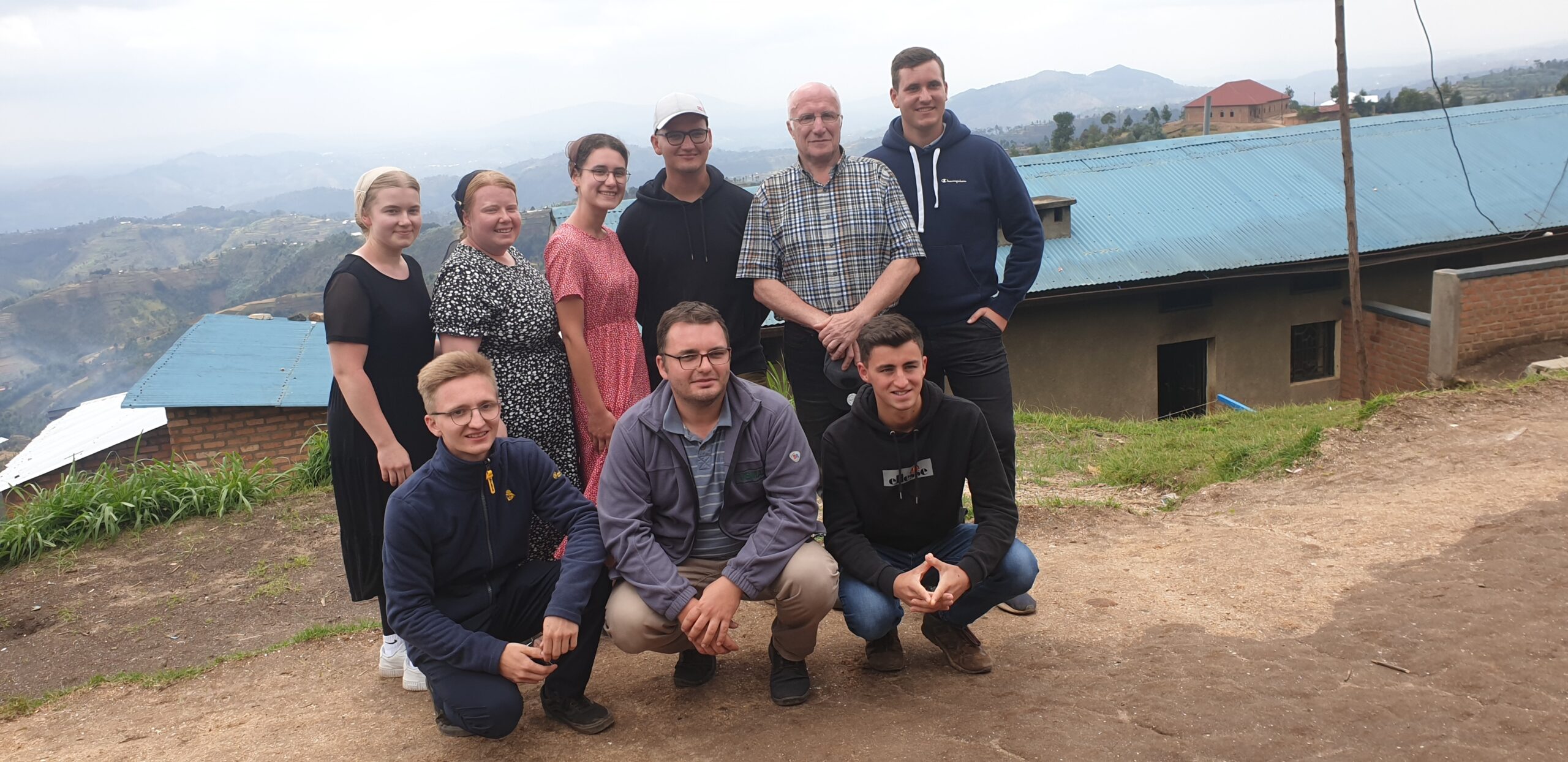
The tour group from Germany
First impressions and errands in Kigali
We started our journey in different parts of Germany and converged in Istanbul, from where we traveled together to Kigali, the capital of Rwanda. There, we were able to gather our first impressions of the country and notice the significant differences to Germany, which we initially had to come to terms with. These differences included the traffic and the security checks in larger stores. We also took care of some shopping here, as we still needed cables to replace the lighting at the warehouse in Rutiti.
We also visited the Kigali Genocide Memorial. This memorial commemorates the horrific history of the Rwandan genocide of 1994, in which nearly one million people died in the most brutal ways. The terrible consequences of this tragedy continue to have a lasting impact.
We also visited the ADEPR Brotherhood church in Kigali and listened to a choir rehearsal. Afterwards, we bought Bibles and hymnals in the local language, Kinyarwanda, to give to some Christians, as not every Christian in Rwanda owns their own Bible.

Packing the beans for the weekly food distribution
The sponsorship project among the people "from the mountain"
Our journey continued to Rutiti, one of the poorest places in Rwanda. In the past, the inhabitants were referred to as "outcasts" or, more disparagingly, as "the people of the mountain." They had little prospect of a better life. But God has not forgotten these people. Now there is a church in the village, and the CDH Stephanus has launched a sponsorship program.
When we arrived, we were immediately given a very warm welcome by a large group of children. For them, it's always a joy when "Mzungu's" (white people) come. On the evening of our arrival in Rutiti, we took the opportunity to talk with some of the children, sing songs, and play games. Since the children's parents often have little time for them and they therefore receive little affection at home, they appreciate it all the more when someone spends time with them.
The next morning began early for us. We enjoyed the sunrise and walked to the beehives. After breakfast, we began our work in and around the warehouse. The brothers replaced the exterior lighting at the warehouse, removing the old lights and installing new spotlights and motion detectors. Meanwhile, inside the warehouse, the sisters packed the weekly food parcels for the families in the village.
Since we wanted to support the local people not only materially, we held a children's service at midday. Brother Eduard Sawal told a children's story about Jesus dying as our substitute for our sins. It was translated so all the children could understand. Brother Paul Moser also gave a short sermon. We also sang songs. Afterwards, the children had lunch. It was a real feast for them, as it included meat, which they only get a few times a year. We also had the opportunity to distribute clothing. In the evening, we were invited to a local church service where we were able to participate with singing and a sermon.

The children's feast
Education creates opportunities for a better life
After visiting Rutiti, we drove along bumpy roads to the vicinity of the beautiful Kivu Lake. There, in Karongi, we visited the school where Jan Berkmans welcomed us. The school provides children not only with a basic education but also with vocational training in various trades, such as sewing. This training enables the children to pursue a real profession and earn money to survive.
The fact that many girls, around the age of 14, are already mothers due to rape makes learning difficult for them. To counteract this, a kindergarten was set up locally where their children are cared for during school hours. To ensure adequate care, there is one caregiver for every two children. The girls come to look after their children from time to time. Here, Diana Ginz, a pediatric nurse, was able to give the young mothers tips on hygiene and childcare. We were also able to distribute clothing that we had brought from Germany. Finally, we enjoyed God's wonderful creation on a boat trip on Lake Kiwu.

Preparation for the installation of the outdoor lighting
Testimonies of God's wonderful guidance
In the capital, there were two places where we could buy Bibles: either in a Bible shop or at a small stall not far from it. We decided to buy the Bibles at the stall so that the profits would support the owner's family. Some time later, Lambert, our guide and translator, spoke with the seller again, and she told him that she had been in great despair the day we bought the Bibles from her. She had been on the verge of abandoning her faith. The problem was that she no longer had any money to support her family. But this purchase of the Bibles solved her financial problem for the moment. It gave her new courage, and she didn't give up her faith. This is proof that God guides our actions and makes us a blessing when we live with Him.
In conclusion, we would like to thank God for a blessed journey, for we were often able to experience how God could use us, directly or indirectly. It is remarkable to see how we were able to bring joy to the people of Rwanda with such small acts. We should take this as an example. We should thank God for everything we have. It is not a given everywhere that we have more food than we need every day, and that every Christian has a Bible. Let us appreciate these things and be thankful.
“Let us not grow weary in doing good, for at the proper time we will reap a harvest if we do not lose heart” (Gal 6:9).
Viola Juschko & Oliver Hohenäcker
Municipality of Bremen-North
Project summary
In the hilly region of Rutiti in East Africa's Rwanda, most residents lack running water, and not everyone has access to electricity. People sometimes have to traverse the mountainous landscape for hours to reach a water source. They live below the poverty line and sometimes work an entire day to earn the equivalent of about €1.50. This wage is impossible to support a family. Many children suffer from malnutrition and often eat only three or four times a week. This is one reason why the child mortality rate is so high. Children's clothing is often too big or damaged. If a secondhand item of clothing is purchased, it has to be worn for several years because there is no money for new clothes. Many children in Rutiti do not attend school or only do so sporadically. They have to work to earn a little money. If these children lack a sufficient education, they have no future prospects of finding employment. If they start their own families, the downward spiral begins anew...
In Rwanda, there are still people who cannot read or write. Daily hygiene and medical visits are unavailable because treatment is only provided upon prepayment, which is too expensive.
We are trying to remedy this situation and maintain child sponsorships in this village. Currently, over 700 children are sponsored through these programs. These sponsorships provide orphans, half-orphans, and predominantly children from extremely poor families with two meals a day, clothing and shoes, school supplies, health insurance for the entire family, and other essential items.
Above all, the children hear the word of God, and people see love in action. This support enables regular school attendance and provides the essentials for survival. Through sponsorship, we aim to support the children until they graduate. Additionally, we try to help the families of the sponsored children as often as possible. On several occasions, we have been able to purchase and distribute food for families. We also constantly strive to empower the local population to help themselves; for example, we have been able to provide several families with goats. Every Friday, each child takes home 1 kg of beans and 1 kg of wheat or corn flour. This is intended to help the families step by step.
For further questions, please contact us at the email address: ruanda@cdh-stephanus-bremen.de.
Donation account:
Intended use: Rwanda
Recipient: CDH Stephanus BV Bremen
IBAN: DE39 2916 5681 0141 4143 00

The hilly landscape of Rwanda