

Podcast: Download (Duration: 12:30 — 8.6MB)
Can a book edited by humans truly be the word of God?
“How can you believe that the Bible is the word of God when it has been altered, falsified, and manipulated by humans over the centuries? Isn’t it clear that the Bible—like other ancient writings—contains errors and human interventions that undermine its credibility as divine revelation?” This is a common objection from skeptics.
This doubt is widespread today. Critics point to the multitude of copies, translations, and the long period between the original texts and the manuscripts available to us today. However, closer examination reveals that the Bible not only retains its historical credibility but has also been repeatedly confirmed. In the following, we will present a selection of apologetic arguments that refute the accusation made in the introduction.
1. The Bible is by far the best-preserved ancient work of mankind.
With over 5,686 surviving manuscripts of the New Testament alone (compared to Homer's 643 manuscripts or Caesar's "Gallic Wars" with only 10 manuscripts, see right image below), the Bible exhibits unparalleled textual fidelity. Critics often claim that errors were introduced through copying and translation. However, studies show that the differences between the copies are negligible and have no impact on the teachings of Christianity.
Despite this overwhelming evidence for the historical credibility of the Bible, most secular schools teach that Caesar and his story are an undisputed fact. In contrast, the existence of Jesus and the transmission of the Bible are viewed with skepticism or barely addressed.
This is incomprehensible, considering that the historical evidence for the Bible is far more extensive and well-founded. The New Testament is and remains in a class of its own! Archaeological finds, such as the Dead Sea Scrolls, also confirm the reliability of the biblical texts of the Old Testament, which have been preserved for centuries.
Whatever doubts we may have about the text of the New Testament, these doubts would have to be multiplied a hundredfold when considering practically all other ancient texts. The manuscripts of the New Testament are closer in time to the original, and their number is far greater than that of any other writing from this period (see illustration below)! While most ancient works and their copies have a time span of over 1,000 years, this span for the New Testament is only 25 to 50 years. This short timeframe and the sheer number of manuscripts allow historians to reconstruct the original text with almost complete accuracy. Thus, it can be stated quite clearly:
The New Testament is by far the best attested Greek or Latin literature of the ancient world.
This underscores another argument: Church Fathers such as Justin Martyr, Irenaeus, Clement of Alexandria, Origen, and Tertullian quoted almost the entire New Testament in their writings up until the 3rd century. The reconstruction of these texts shows that, with the exception of 11 verses, the entire New Testament can be reconstructed using them! Generally speaking, in the reconstruction process, the more copies are used, the more likely it is that the original text will be found.

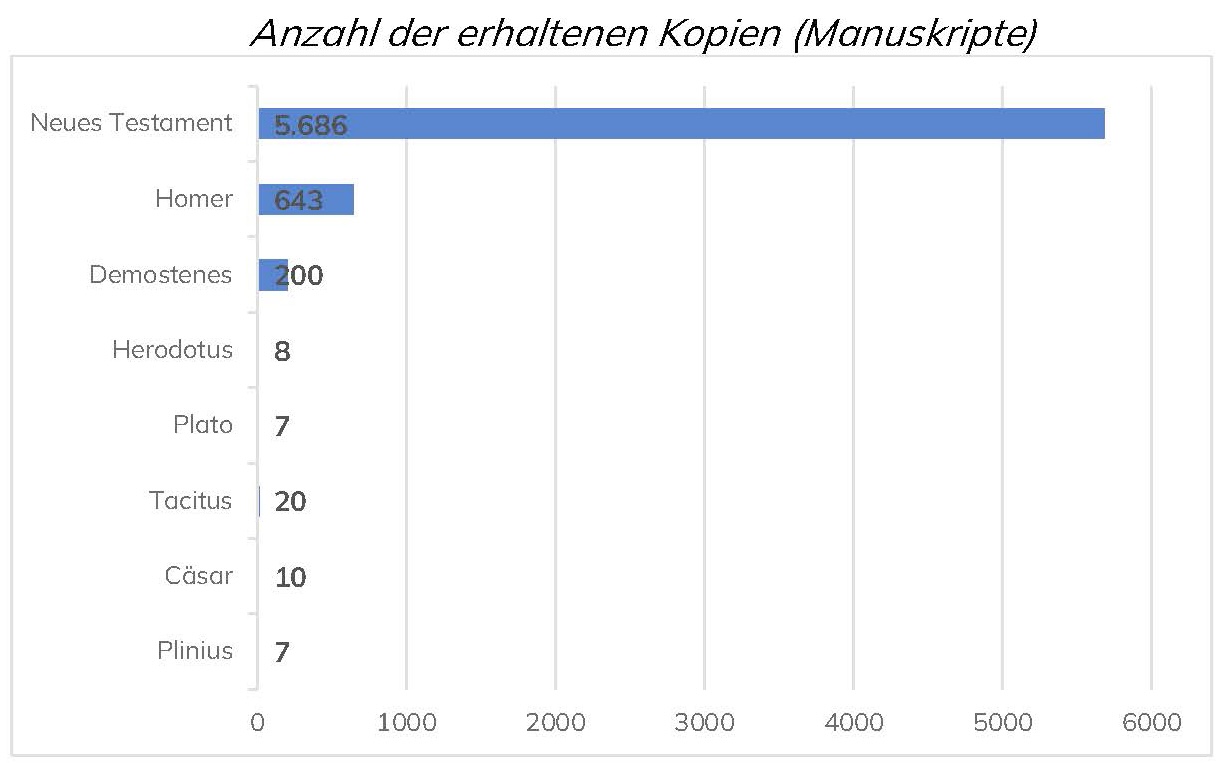
(Source of diagrams: Geisler/Turek (2018): Um Atheist zu sein, fehlt mir der Glaube, 1st ed., Bielefeld: CMV, p.247)
2. The indestructibility of the Bible through centuries of persecution
No other book in history has been persecuted and targeted for destruction as often as the Bible. In the Roman Empire, Emperor Diocletian issued an edict ordering the destruction of all Bibles. Those who refused to surrender their Bibles were put to death. Yet despite these violent attacks, the Bible survived and, in the following centuries, became the most printed and widely distributed book in the world. The medieval Church also attempted to restrict access to the Bible by prohibiting its reading in the vernacular. Nevertheless, reformers like Martin Luther fought to make the word of God accessible to all people.
The fact that the Bible survived such massive persecution is a testament to its supernatural preservation. No human book could have survived such an attack. A.W. Pink (2016) writes the following in his book "The Divine Inspiration of the Bible":
Imagine a person who had lived on this earth for 1800 years. Many attempts to drown him in the sea would have failed. He would have been thrown to wild animals that could not swallow him. Countless times he would have drunk poison, yet not once would it have harmed him. He would have been bound in iron chains and imprisoned in dungeons, yet he would always have been able to throw off the chains and free himself. He would have been hanged repeatedly until his enemies declared him dead. But each time they took him down from the gallows, he would have stood up and walked around as if nothing had happened. Hundreds of times he would have been burned at the stake until nothing remained of him. But as soon as the fire died down, he would have risen again from the ashes. There is no need to elaborate on these thoughts further. Such a person would be a superhero, an absolute miracle.
This is exactly how we must view the Bible, for this is how it has been treated. It has been burned, drowned, chained, locked away, and torn to pieces—yet never destroyed. No other book has faced such fierce resistance as the Bible, making its preservation one of the most astonishing miracles. Yet, 2,500 years ago, God declared, “The grass withers and the flower fades, but the word of our God endures forever” (Isaiah 40:8). Just as Daniel’s three friends passed unharmed through Nebuchadnezzar’s fiery furnace, so the Bible was rescued from the furnace of satanic attacks without even the smell of smoke. Just as earthly parents keep their children’s letters , so our heavenly Father protects the love letters He has written to His children” (p. 96).
3. The Fulfillment of Prophecies: A Divine Fingerprint
A key aspect that distinguishes Christianity from other faiths and scriptures is the fulfillment of prophecies. The Bible contains approximately 2,500 prophecies of various kinds. These relate to individual nations, to Israel, to specific historical events, and to individuals, especially the coming Messiah, Jesus Christ. In the Old Testament alone, there are over 300 predictions that directly relate to the coming, life, death, and resurrection of Jesus. Remarkably, every single one of these prophecies was fulfilled in Jesus Christ. These prophecies, often written centuries before the actual events, have been fulfilled with a precision that defies human explanation.
Examples such as the prediction of the destruction of Jerusalem in 70 AD, the birthplace of Jesus in Bethlehem (Micah 5:2), or the prophecy of the Messiah's suffering (Isaiah 53) demonstrate that the Bible is not merely a history book, but a book of divine knowledge. Of the 2,500 prophecies in the Bible, approximately 2,000 have already been fulfilled. This reliability is unparalleled in any other ancient or religious literature. The remaining 500 or so prophecies pertain to future events, particularly the end times, as described in the Book of Revelation.
4. The resilience of the Bible in modern times
In the modern world, attacks on the Bible have changed. While in the past physical destruction was the goal, modern criticism aims to intellectually undermine the Bible's credibility. Critics label the Bible as outdated or a collection of myths. Yet despite these modern attacks, the Bible remains a bestseller. Millions of people still experience it as a source of truth and wisdom that transforms their lives.
In conclusion, the Bible is more than an ancient document or a religious book. Its indestructibility amidst persecution, the overwhelming evidence for its textual accuracy, and the fulfillment of prophecies demonstrate that it originated from divine hands. How could a book so long persecuted and attacked have survived if it had not been preserved by God himself?
The strongest argument for the Bible's reliability, however, is experienced by believers in its application ! The Bible works, and God keeps His promises! The greatest power lies in this very real experience of a living relationship with the One behind the Bible. This distinguishes the Bible from every other book in the world. It is not merely a historical document or a collection of wisdom, but the living Word of God , actively at work in people's lives. Critics may repeatedly claim that the Bible is corrupted or irrelevant, but its continued existence and impact speak a different language: "Heaven and earth will pass away, but my words will never pass away" (Matthew 24:35).
As Dietrich Bonhoeffer (1906–1945) aptly put it: “I believe that the Bible alone is the answer to all our questions and that we only need to ask persistently and humbly in order to receive the answer from it.”
Thomas Fenske
Tellig municipality
Further book recommendations related to point 1:
- Stefan Gustavsson (2018): No reason for skepticism! Eight reasons for the credibility of the Gospels, Cuxhaven: Neufeld Verlag.
- Warner and Susie Wallace (2023): Cold Case Christus – Unsolved Cases – Christian Faith for Kids, 1st ed., Dillenburg: CV.