
Report on the trip to Bihar (India)
After almost 15 years, I'm visiting India again. I was very curious to see if much had changed in those years, or if time had stood still there. This time, we visited the mountainous region around Darjeeling and the state of Bihar (GEMS – Jebakumar) on our trip.
What immediately struck everyone in the tour group was the sheer number of people on the streets of India. Since we were traveling just before Christmas, I kept thinking about the Christmas markets in Germany. The streets in India are similarly crowded, from morning till night, seven days a week, 365 days a year. Everything is still as it was: people, people, people. Interspersed among them are the sacred cows and a lot of garbage that the people in India simply aren't able to dispose of properly.

Brother Ernst Fischer and his tour group visit Brother Jebakumar
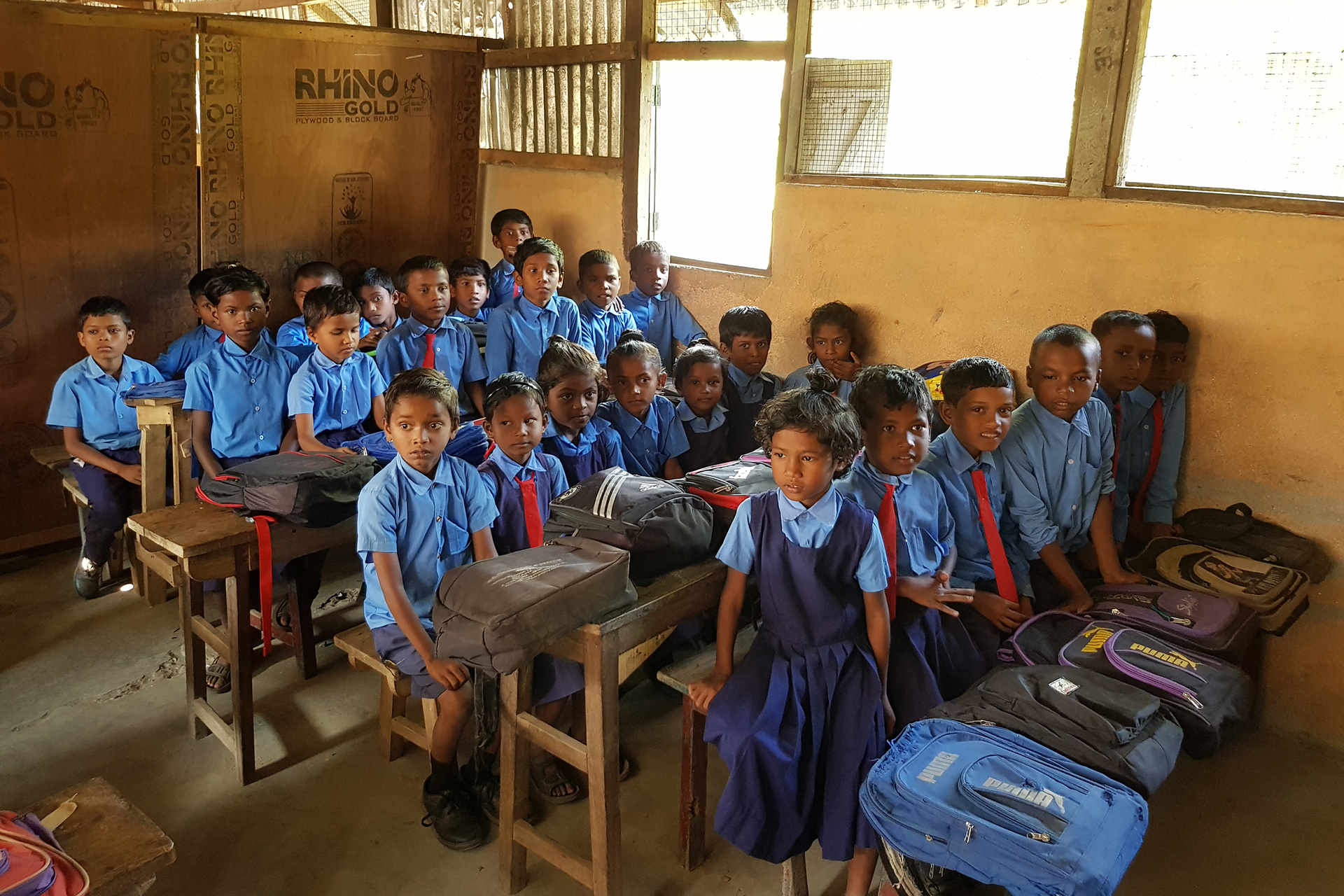
In New Glencoe, we visited a school where over 300 children receive an education in a Christian atmosphere. They are all children from the tea plantations of the mountain region. After visiting this school, we had the idea of buying New Testaments so that every child leaving the school could take at least one with them as a companion on their journey. We put this idea into action immediately.
During our trip through the mountains of Darjeeling, I was moved to tears as I thought about how little cost and effort it takes to be a blessing to the people in the world's most populous country, if only we wanted to. How much good could be done if every Christian in the world went through life with the burning desire to be a blessing somewhere and helped to spread the Gospel throughout the world.

During their free time, the children were given lots of activities.
Bihar, with an area of 94,163 km² – significantly smaller than the former East Germany – is home to 104 million people. Approximately half of them are illiterate. Among women, the figure is even higher, at 60%. Bihar is the poorest state in India, and its inhabitants rely primarily on agriculture. Rice, rice, and more rice as far as the eye can see. It is still harvested using the same methods as 3,000 years ago: with a sickle.
As we drove through the country and saw people bringing in the harvest with sickles, then carrying the sheaves home on their heads, and finally beating the rice from the ears of grain on "wooden beds", I kept thinking of Ruth from the Bible, who gathered ears of grain from the field.

A few mud huts,
just like 3000 years ago
We visited several GEMS village projects and felt like we'd stepped back into the Stone Age. We saw mud huts with thatched roofs, food cooked over open fires, and because there are hardly any forests in Bihar, cow dung is used as fuel. People harvest everything by hand; machines and other technology are rarely seen.
But far worse than the backwardness of the people in Bihar is the idolatry in which they are trapped. They live in spiritual darkness. Brother Jebakumar told us that Hindus believe they can be reborn up to 64,000 times, and therefore they don't worry about eternity, because no one knows which rebirth (which life) they are currently in.
I was once again struck by the lies with which the devil seduces people and thereby robs them of eternal life. The Bible doesn't call the devil "the father of lies" for nothing. And yet, even in this dark region, God is at work. We were absolutely amazed when, during our stay at GEMS, we saw what God had already accomplished through this one missionary in the land that was then called "the missionaries' graveyard."
But when we were invited to visit his house before our departure and, amazed by the scale of his work, showed him the handiwork, he replied wistfully and humbly: “It is true, but compared to the work that still needs to be done, it is very little.” India has 1.3 billion people, and only a tiny fraction of them are Christians. Yet God is at work, and even in this underdeveloped country, Christians experience God's presence and his miracles. I would like to share a story that Brother Viktor told us on the GEMS campus. It is one of many that inspired us.
Brother Jebakumar has also been working on Rahab projects for some time. There are villages in Bihar where women live exclusively through prostitution and don't see anything wrong with it. It's simply their way of life, and they don't perceive any wrongdoing behind it. As one can easily imagine, this results in many children being born who then become victims of this terrible way of life.

Children who are cared for and taught as part of the Rahab project.
In one such Rahab project, where about 100 children are cared for, fed, and also educated through school and Christian education every day, a thorough medical examination revealed that 22 of these children were HIV-positive or had hepatitis B.
The doctor who examined the children told the staff that some of them only had a few months to live because their illness was very advanced. But then Good Friday arrived, and the children gathered for a fasting prayer meeting. They fasted that day and spent the entire day in prayer, praise, and God's word.
That evening they had a special experience; God had visited them. The children were filled with the Holy Spirit in a special way, rejoiced, and praised God in a truly supernatural manner. A few weeks after this experience, one of these sick children had to see a doctor because he wasn't feeling well.
The doctor was told that this boy was HIV-positive and that he should exercise particular caution when treating this patient. The doctor conducted a thorough examination and then told the GEMS officials that there must have been a mistake, because the boy was not HIV-positive at all.
Subsequently, the other children with this diagnosis were also examined, and the disease could no longer be detected in any of them. To be absolutely certain, the examination methods of the two doctors were compared, and it was found that they had used the same method in both cases.
God miraculously healed these children. Praise be to God for that. Jesus Christ is the same yesterday, today, and forever.
How important it is that we as Christians recognize this vast field of work and, united in all our efforts, contribute to ensuring that the Gospel reaches people even in such underdeveloped regions as Bihar. We still have good opportunities to support missionary work, for example, through intermission.
Jesus gave his disciples the commission: Go into all the world – are you already among them?
Ernst Fischer
Municipality of Cloppenburg


