
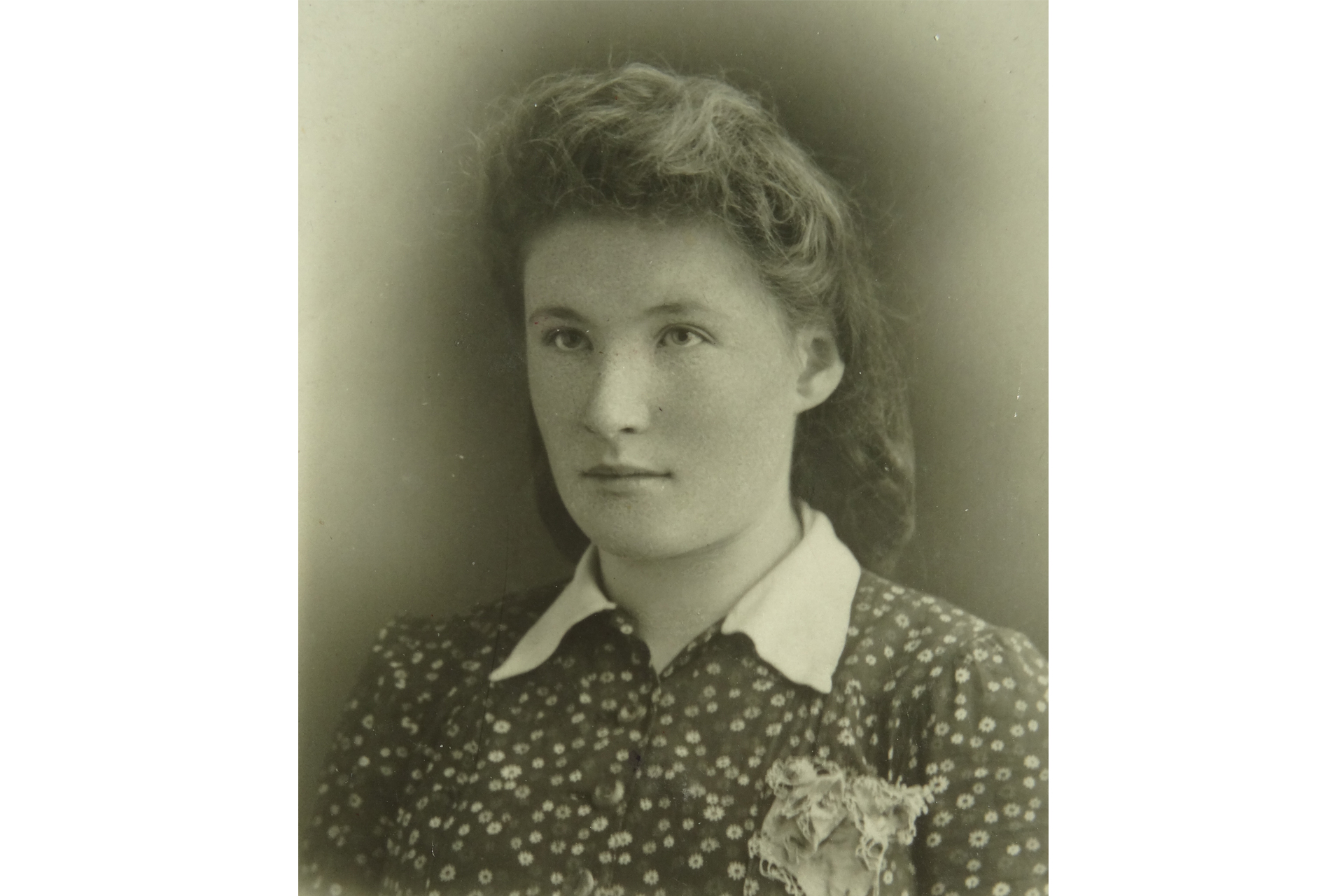
Memories from the life of Katharina Kliwer * 22.02.1929 + 23.11.2020
30. November 2021 · 6 Min. lesen
Podcast: Download (Duration: 13:57 — 9.6MB)
Before the war began
Rosengart, a German village in what is now Ukraine, was my home. There I, Katharina Kliwer, née Bergen, was born in 1929, the second of five children. The village of Rosengart belonged to the Mennonite colony of Chortitza. My father worked on the collective farm, and my mother suffered from polyarthritis and was therefore unable to walk independently. Religious services were strictly forbidden at that time, and there were no places of worship. Thus, as a child, I was unaware of any Christian gatherings.
At school, we were taught that there was no God. But my mother instilled faith in our hearts from an early age, so the school's atheistic teachings had no effect on me. If someone reported a family to the government that they owned a Bible, the father went to prison. Mom told us about God and read to us from our German Bible, but only with the windows and doors closed.
Under German occupation
The German-Soviet war began in 1941, and with the German Wehrmacht's invasion of the Soviet Union, our childhood came to an end. I was twelve years old at the time, and our youngest brother was just eleven months old.
All the men in our village were drafted into the Trudarmee (a labor army for Germans as an alternative to military service). Only women, children, and a few old men remained. Our father was also taken away. The following day, German soldiers came to our village and occupied it. With the outbreak of war, our struggle for survival began. But there was someone who cared for us and didn't abandon us. In the search for food, the children had to help: together with the adults, we worked in the fields and dug up potatoes. The wheat fields had been burned by the retreating Russian troops.
During the German occupation, we were given permission to hold church services, something that had previously been unthinkable. The whole village, all the women and children, went to the gatherings. I still remember everyone weeping and fervent prayers rising up. Everyone was in deep sorrow because every family had to cope without a father, and the uncertainty of where the men were gnawed at every family. There was a call to pray for all the fathers, that God might bring them back.
Evacuation to Germany
Two years passed. The Russian Wehrmacht began to advance westward again, forcing the Germans to retreat. In the autumn of 1943, Russian troops broke through the front, and our entire village was evacuated to Germany, to Chemnitz-Klaffenbach. We lived there for two years. In the winter of 1944, extensive bombing raids by America and England began. Everywhere we heard of heavy Allied bombing raids, and we lived in constant fear of death.
By February of the following year, Dresden and our region had also become targets. Then came the terrible night Chemnitz was bombed. We had already gone to sleep when the sirens wailed. Fifteen of us sat in the air-raid shelter, waiting in dread to see what would happen to us. One explosion after another echoed through the air. That horrific night remains vividly etched in my memory. Huddled close to my mother, we huddled together. If we were to die, then only together!
It was a deafening noise. The earth shook from the intense air pressure, and the ground rose and fell. Mama calmed us, comforted us, and prayed silently for the Lord's protection. She also encouraged us to pray. The extent of the devastation after this bombing is difficult to describe.
Deportation to Siberia - Life in the Taiga
On May 8, 1945, the war ended with the unconditional surrender of the German Wehrmacht. The Russian soldiers came and promised us a return to our homeland, which later proved to be a deception. First in passenger cars, then crammed into cattle cars, our journey to Siberia began. We never saw our homeland again.
It was October, and it rained and snowed intermittently. Depending on where you sat, your clothes would get soaked from the dripping roof of the train car. About a month passed, and our food supplies dwindled. We were helplessly exposed to the misery, hunger, and abuse by Russian prisoners of war. Under these circumstances, an epidemic broke out. Dysentery struck, and our mother arrived in Siberia deathly ill.
Because her clothes got wet from the dripping roof of the cattle car, she developed pneumonia. Her fever rose to 40 degrees Celsius (104 degrees Fahrenheit). That first night in the cattle field, we thought she was going to die. She was taken to the hospital in a horse-drawn cart. Before leaving, she tearfully said goodbye to all of us, thinking she wouldn't return alive. But God gave us our mother back, and we were able to spend almost another year with her.
In the winter of 1945, our family was quartered in a chicken coop on the collective farm. Without any means of survival, surrounded by the forest, the taiga. The chicken coop stood in the middle of the taiga, where about 13 of us lived. We lived in approximately 20 square meters and slept on the earthen floor. In the center stood an iron stove. My sister Margarethe and I often went into the forest to chop wood. It was a grueling struggle for survival. In the spring, when the thaw began, we gathered frozen potatoes from the previous year in the fields and baked flatbreads from boiled potato peels on the iron stove. We made soups from nettles and other shrubs. We thought that one could not survive without bread and money, but the grace of God miraculously kept us alive. For this, be the glory!
Quite unexpectedly, one day we received a letter from our father, who was living in Tomsk at the time and waiting for permission from the commandant's office to come to us. Summer arrived, and our mother's health steadily declined. In August 1946, our mother died in the chicken coop, and we were left alone as orphans. Ten days later, our father arrived, and we met his wife at her covered grave in the taiga. Since our father had to return to Tomsk, we children lived alone for another year. But God provided for us and brought us to our father in Tomsk in 1947.
My conversion
In August 1951, I converted to Christianity at the prayer house in Tomsk, joining a Baptist church. At the same time, the Pentecostal movement was beginning there. We learned about the Holy Spirit through letters from friends in Ukraine and began to pray for it. Soon, a congregation of born-again Christians, baptized with the Holy Spirit, was formed. The message and teachings of the Holy Spirit spread quickly, and the Pentecostal church grew. However, we were like sheep without a shepherd, because we had no pastor or teacher to instruct us. God saw this and sent us people from Central Asia.
Initially, it was older sisters through whom God worked and who instructed us. Since we had no prayer house, we often went to the Tatar cemetery at night. Kneeling in the snow, we sent fervent prayers up to God. One December night, a small group of us went again to the deserted Tatar cemetery to pray. During this prayer, around 1 a.m., the Lord sealed me with the Holy Spirit—with the sign of speaking in tongues. We stood on our knees in the deep snow, and God filled me with an indescribable joy of the Holy Spirit. It became clear to me that everything God had allowed in our lives had worked for our good. God's ways are wonderful.
The Pentecostal church in Tomsk was growing, and I was among the first to be baptized with the Holy Spirit. After some time, God miraculously sent us an older brother from Central Asia named Afanasav Mikhailevich from the Frunze Oblast, near the town of Kant. He was an elder of the Pentecostal churches. In this way, God sent us laborers from His vineyard so that His church could be built up. When Brother Jakob Wiebe, a German preacher, came to Tomsk, we told him about the Holy Spirit, and he too began to pray for it. We often went into the forest to remain there in prayer. It seemed as if God was even closer to us under the open sky. The Holy Spirit brought much joy to our hearts there, and the grace of God remained with us.
"We are still standing on the bank, by a large river."
"Waiting for the crossing to return home."(Translated from Russian)
As the sun set over the river, our song rang out, as if the angels were singing with us. Such was our joy. Unforgettable, as if heaven itself rejoiced and triumphed with us.

Sister Katharina Kliwer
epilogue
Katharina Kliwer wrote down many memories, repeatedly emphasizing God's grace in her life and the power of prayer. Through God's wonderful guidance, she was able to marry Johann Kliwer in Chelyabinsk in 1959. They were blessed with five children. In July 1989, they emigrated to Germany and became members of the congregation in Miesau. In 2010, Katharina lost her husband. Despite all the difficult circumstances in her life, she trusted in God. She performed the ministry of prayer for the congregation and her family sincerely and with complete devotion, even when she was physically very weak. On November 23, 2020, at the age of 91, Katharina Kliwer went home to her Savior, for whom she had so deeply longed.
Helene Roth
Municipality of Speyer