

Podcast: Download (Duration: 12:23 — 8.5MB)
The answer to this question is not as straightforward as it might first appear. The word "Gospel" comes from ancient Greek and means "Good News" or "Good Message." However, we live in a world where many different versions of this Good News circulate. Within Christian circles, there are many interpretations that have lost clarity regarding what the Gospel is and what it is not.
Where do we stand?
The situation just described creates space for incomplete versions of the Gospel. These are interpretations in which the emphasis is misplaced, where some points are added and others omitted. There are proclamations of the Gospel that address topics not found in the Bible. Furthermore, promises are made to people that God never promised or that are even completely unbiblical. Often, the emphasis is placed on God's love, while the fact that sin makes us enemies of God is concealed.
This leads the listener to question why Jesus' sacrifice on the cross is necessary. Others preach a gospel that tells people Jesus makes their lives better. They have fewer worries, problems, and illnesses with Him. But when life suddenly becomes difficult, they go through a crisis, or become ill, they ask where this Jesus is and lose their (already inauthentic) faith.
Back to the beginning
This makes the following question all the more important:
What is the Gospel?
To answer this question, we must begin with another: What did the disciples tell other people after Jesus' resurrection? They didn't tell fairy tales, nor did they primarily delve into complex theological insights. They recounted what they had seen and experienced. Their testimony was that Jesus had risen from the dead. This event was an absolutely central point in their preaching. Theological connections and the apostles' teachings only gradually came together because the apostles understood certain things step by step. But the beginning of it all was this historically unique and salvation-historically significant event: Jesus is risen. No one is exempt from this message, as it has incredible implications.
If this is truly true, then on the one hand it has incomprehensibly far-reaching consequences for everyone, but on the other hand it also offers a glorious prospect. One must first imagine the dramatic grief and disappointment of the disciples after Jesus was no longer with them. They had spent over three years with Him day and night. During this time, they had experienced unimaginable things and learned directly from the Son of God. And suddenly He was dead. They had to process this. Some probably used the Sabbath to reflect, pray, and contemplate. But there was hardly any time. On Sunday, the third day after Jesus' crucifixion, Jesus was no longer in the tomb. He had risen! And as this news spread, some hearts and empty souls were revived.
Some were certainly astonished, somewhat skeptical, or even unbelieving. But in fact, hundreds of people saw the risen Son of God with their own eyes shortly afterward. No one in Jerusalem needed to be told that Jesus had died. This event was known to everyone, but the fact that He was no longer dead—that was something the disciples had to tell everyone—first and foremost, their own people. Imagine the uproar among the priests and the Romans, but also among the disciples and all His followers.
After 40 days, Jesus ascended into heaven and commanded the disciples to remain in Jerusalem until He sent His Advocate, the Holy Spirit. When this happened ten days later, nothing and no one could stop these men. They joyfully recounted what they had seen: Jesus was not dead, but alive. This was the central point of their sermon.
A wildfire spreads
But now comes something important:
What are the consequences for each individual?
The result is that we can be freed from our guilt before the eternal and holy God forever. And that is what the disciples proclaimed to the inhabitants of Jerusalem during the very first evangelistic outreach. They recounted what had happened. The Holy Spirit moved the hearts of the listeners, and the people asked, "What should we do now?"
Peter gave the clear answer: “Repent!”
Repentance means that I completely and radically turn away from my sinful way. Then God will forgive me my guilt and give me a new heart with a longing for truth and righteousness, and with the incredibly glorious prospect of eternal life in heaven with Him. Thus, in exchange for our sin and our corrupt and punishable lives, God grants us forgiveness and purification through the atoning death of His Son.
Wonderful! Anyone who has experienced this cannot remain silent about it. This isn't simply a lottery win that seemingly brings a few years of happiness. No, it eliminates the root cause of all wrongdoing and sin, opening up a perspective we could never have dreamed of. This is something every human being longs for.
To know that our hearts are pure, content, happy, and secure in the hands of our personal Savior, in whom we can look with complete hope and trust in every situation, no matter how dire. Especially now, in these turbulent times, filled with many dire warnings and the clamor of war, which can be frightening, oppressive, lonely, or hopeless for most, it is important to proclaim the Good News.
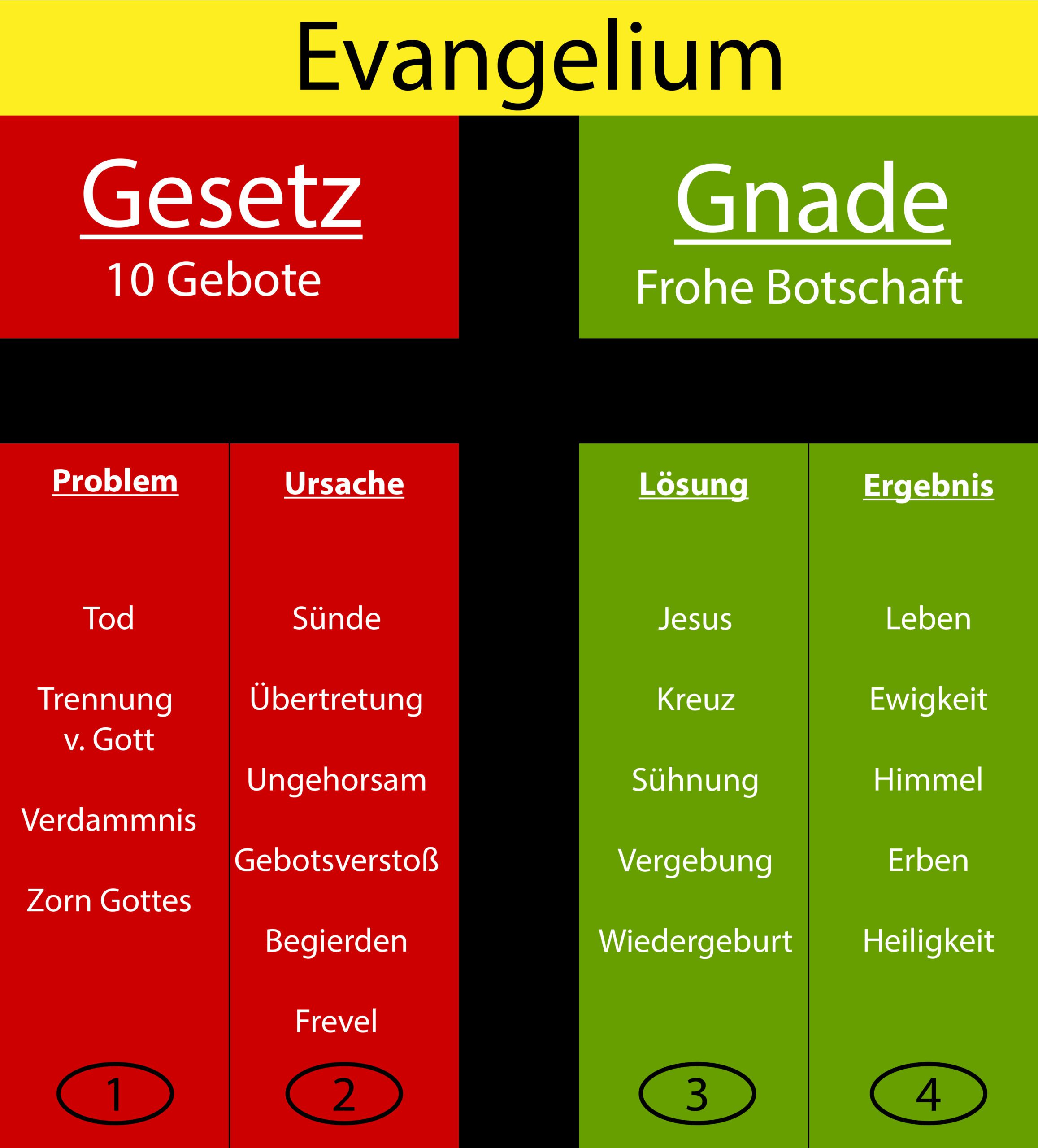
Do you recognize the cross as the central message of the Gospel? There, law (judgment) meets grace (freedom). Here, God's holy wrath is rightfully appeased, and His love is bestowed upon us as an act of grace. And this Gospel is the foundation and starting point of our holy, God-given life (cf. Eph 2:1-10).
Helpful guiding structure for proclamation
The Bible paints a picture of humanity that we don't particularly like. In the second chapter of his letter to the Ephesians, Paul outlines the Gospel for us and bases this outline on four pillars. Try reading the first ten verses calmly (perhaps several times), discovering their inner structure and understanding the logic behind them. Once this has truly sunk in, every conversation and every sermon will be much easier for us, because it's always about the same thing.
What's going on? (see graphic, point 1)
- We are all on the way to hell (No, not a quote from AC/DC).
- Unless we repent, we will perish and be separated from God forever (Luke 13:3, 5).
Why is that? (Point 2)
- The cause of separation from God is sin (Rom 3:23).
- God is angry because of our sin. Not because He is malicious, but because He is holy. He punishes us for it with death (Romans 6:23a). That's how serious God is about sin.
The cross of Golgotha is the solution:
What can I do? (Point 3)
- Accept this gift! Jesus Christ died on the cross: He paid for all the sins we would have had to pay for.
- Jesus offers forgiveness of sins. Whoever recognizes their guilt, repents and confesses it, and turns away from it, can lead a life with God.
What happens at the end? (Point 4)
- The problem is solved. We don't have to end up in hell. We are saved.
- Ultimately, this means an eternity with the Lord Jesus in heaven.
What a wonderful message! What a glorious way out of our life-threatening misery and hopelessness. The Ten Commandments represent God's moral law: we have all broken it. That is a sad fact and truth. But Jesus pays for this sin on the cross of Golgotha. Thus, we can go unpunished. It is incredible what jubilation and joy it must bring to a lost person when they are suddenly given such change and prospect. That is the power of God.
Neither to the right nor to the left
However, we also run the risk of not conveying the complete gospel in our preaching and thus diminishing its full power.
We should pay attention to these points:
- Do not only draw a God of love, but also of wrath (the holiness of God).
- Describe not only heaven, but also mention the real, looming danger of hell (God as judge).
- Show the love of God in the fact that He gives Himself as a sacrifice.
- Only when we begin to understand the dramatic consequences of sin does this sacrifice of Jesus become so precious and overwhelming for us personally (awareness of sin).
- Preach the whole message, not a part of it. Do not emphasize any particular aspect (e.g., only God's love or only God's wrath).
The Gospel is a message that has the power to completely and radically transform lives. Our task is to keep this Gospel pure and to pass it on so that it can accomplish its work.
In his letter to the Galatians, Paul speaks to us and says: “I am astonished that you are so quickly deserting him who called you to the grace of Christ and are turning to a different gospel—which is really no gospel at all. There are only some who are throwing you into confusion and want to distort the gospel of Christ. But even if we or an angel from heaven should preach to you a gospel contrary to the one we preached to you, let him be accursed! As we have said before, so I say again: If anyone is preaching to you a gospel contrary to the one you received, let him be accursed” (Galatians 1:6-9).
Forward in reverence and courage!
God takes it very seriously that we proclaim His Gospel correctly. This should fill us with respect for the task of evangelism and, at the same time, with joy. What an honor that God entrusts us with this task! Therefore, dear reader, I want to encourage you to understand this Gospel from Holy Scripture in its profound truth, to accept it with personal gratitude, and to remain close to the One who Himself became this joyful and saving message: Jesus Christ, the Son of the eternal God.
This empowers us to fulfill Jesus' great mission by sharing this personally experienced gift of hope and love with all people, wherever God makes it possible, and by praying for them.
Viktor Hoffmann,
Municipality of Miesau