

Podcast: Download (Duration: 30:29 — 20.9MB)
At Pentecost, God founded the church through the work of the Holy Spirit. As the message of the gospel spread to other places and many people converted, local churches were also established there and cared for by the apostles. Even today, every Christian needs a church.
The structure and purpose of the church are explained in detail in the Bible. Therefore, it is important to engage with them personally. When we become aware of the church's mission and what personal belonging means, we recognize its value. Even though the church is made up of people like you and me, it is important to continually remind ourselves that God himself is the initiator of the church. He himself founded it.
This shows us the importance of the church and should fill us with awe. The highest institution and community the world has ever possessed is without doubt the Body of Jesus Christ, embodied by His church, because the church is not a collection of just any people, but of the people whom Christ redeemed with His own blood (cf. Acts 20:28).
The purpose and function of the body
In the New Testament, we see the day of Pentecost as the birth of the New Testament church. Here, God personally does something extraordinary by calling a people to Himself through the Holy Spirit. “For we were all baptized by one Spirit into one body—whether Jews or Greeks, slaves or free—and we were all given the one Spirit to drink” (1 Corinthians 12:13). “Those who accepted his message were baptized, and about 3,000 were added to their number that day” (Acts 2:41).
Where were they added? “They praised God and were well regarded by all the people. And the Lord added to their number daily those who were being saved” (Acts 2:47).
It is interesting to see the significance God gives to the church through His intervention. Baptism in water and the Spirit is the beginning of joining the church—the joining of the saved and of the Lord Himself. Thus, the term "church" retains its clear literal meaning in both the Old and New Testaments.
In Hebrew, "Edah" means " assembly of those who act/witness together," and in Greek, "Ekklesia" means " assembly of the called-out ." Just as God called His people Israel out of Egypt as a church, so He calls believers in Christ from the world into the church.
Another function of the Hebrew-derived word "Ed" is "testimony." This illustrates the fundamental task of the church as a witness: "But you will receive power when the Holy Spirit comes on you; and you will be my witnesses in Jerusalem, and in all Judea and Samaria, and to the ends of the earth" (Acts 1:8).
Thus, the church is clearly called out of the sin of the world to be a witness and a guide to salvation through Jesus Christ for this lost world. This often leads to a debate about the tasks of the church, which can consequently result in different developments among local congregations because priorities are placed differently.
One side strongly advocates for the Great Commission, aiming to reach as many people as possible with the good news of the gospel. The other side emphasizes internal work within the church to preserve pure doctrine and its separation from the world. According to Scripture, both should be carefully considered and complement each other, as they are interdependent.
If the focus is solely on reaching outsiders, neglecting the deepening of biblical knowledge, consistent prayer, and spiritual growth, a church risks losing its doctrinal firmness and its understanding of godly holiness. This also diminishes its power to reach people in the world. The world doesn't need a worldly or concert-like worship service. It already has enough of those. It needs the transformative power of the witness of the pure gospel.
If the church works only inwardly and inwardly, it loses the compassion and burning love to seek what is lost. Christ's commission to make disciples can be perverted into religious and selfish Pharisaism. Therefore, it is essential for every local church to constantly pursue these two goals: reaching people in this world with the Gospel and striving to become more like Christ in every aspect of its own life.
God himself founded the church.
Membership in the local community
Membership in a local church, both in its physical and spiritual life, is also founded on Scripture and testifies to belonging to the body of Christ. If we examine the term "church" more closely in the New Testament, we can speak metaphorically of three entities that are referred to as a church.
- The local church said: “Write what you see in a book and send it to the churches in Asia: to Ephesus, Smyrna, Pergamum, Thyatira, Sardis, Philadelphia, and Laodicea!” (Revelation 1:11b).
- The church as the general church of Jesus Christ: “And he is the head of the body, the church; he is the beginning, the firstborn from the dead, that in everything he might have the supremacy” (Col 1:18).
- The church as a present assembly: “If now the whole church were to come together in one place” (1 Corinthians 14:23a).
Thus, the New Testament speaks quite naturally about the church in all these areas, emphasizing its necessity. A local church is a church that also meets regularly. The church of Jesus Christ consists of its members who live according to the standards of Holy Scripture and belong to their local church.
The first church in the Acts of the Apostles serves as a model. Its shared and goal-oriented approach can be described using the following criteria: “And they devoted themselves to the apostles’ teaching and to fellowship, to the breaking of bread and to prayer” (Acts 2:42).
This verse allows us to understand the approach of the first believers as a church. Our focus in designing our worship services should not deviate from this pattern in order to achieve the same results. The first thing mentioned here is their consistency. Therefore, what matters is not isolated actions or those repeated over extended periods, but rather the sustained commitment to consistency.
What should a community constantly deal with?
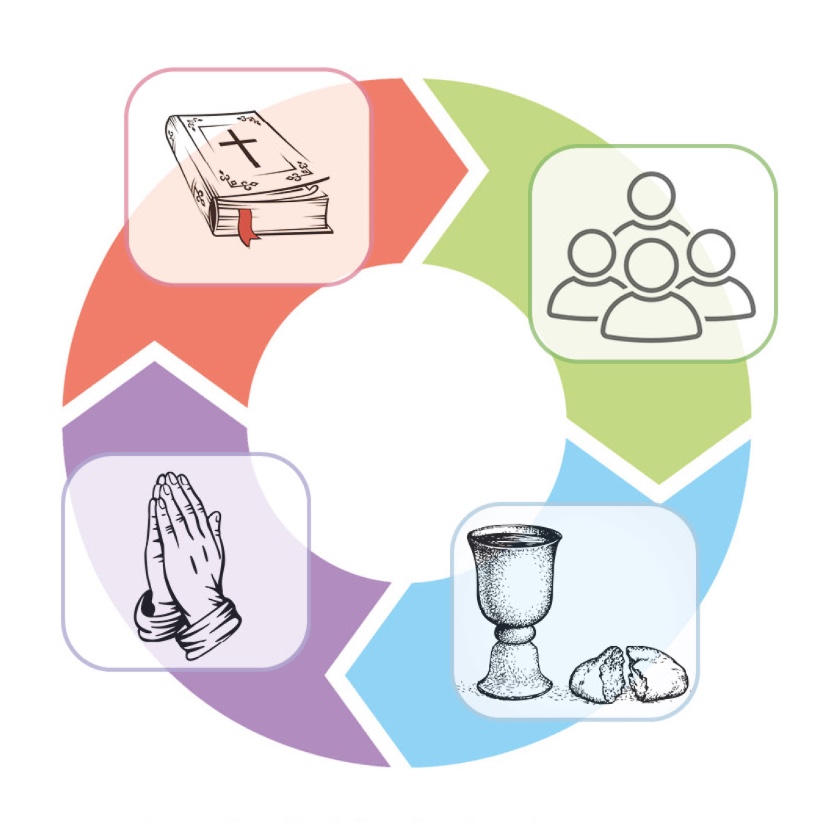
Just like the members of the early church, we too need for our spiritual life a constant commitment to doctrine, fellowship, the breaking of bread, and prayer. If a member's spiritual life becomes unbalanced, then at least one of these aspects has been neglected.
1. Teaching of the Apostles
In the scriptural and faithful tradition of the apostles' teachings. The apostles were guided by the Holy Spirit and were, for the most part, witnesses to Jesus' life on earth. All the authors of the New Testament were followers of the first generation after Christ. Here, the life of Jesus on earth is recounted in detail. Furthermore, the letters to the churches, like the Book of Revelation, were mostly addressed to local congregations.
“John to the seven churches in Asia: Grace to you and peace from him who is, and who was, and who is to come, and from the seven spirits before his throne” (Revelation 1:4). “To all those who are in Rome and loved by God, and called to be saints: Grace to you and peace from God our Father and the Lord Jesus Christ” (Romans 1:7).
“And when the letter has been read among you, see to it that it is also read among the church of Laodiceans, and that you also read the one from Laodicea” (Col 4:16).
Based on these facts and scriptures, we can once again see how important the local churches are to God and how important the teaching of the apostles is for us, which was written down in the letters to the local churches.
2. Community
Community is a physical togetherness, not merely a literal or technical transmission of information. In community, information can also be perceived through tangible presence, and emotions are shared and experienced in a completely different way. Community is a fundamental need that God himself placed within humanity and cannot be replaced by virtual technology.
To exist as a local church, as exemplified by the apostles, constant fellowship is essential. They didn't gather simply because technology wasn't as advanced then as it is today. After all, they had written communication, which they used, but by no means limited themselves to.
“I constantly plead in my prayers that I might not, by God’s will, finally be able to come to you. For I long to see you, to impart to you some spiritual gift, so that you may be strengthened” (Romans 1:10-11). “For this reason we, Paul, also wanted to come to you once, even twice, but Satan hindered us” (1 Thessalonians 2:18).
Here it is even shown who desires this kind of fellowship and who seeks to prevent it. We also know that almost all the letters to the churches were addressed to congregations that had previously been founded through the personal presence of the apostles and cared for over a certain period.
3. Breaking of bread
The breaking of bread, also called the Lord's Supper, is a very special kind of union of a congregation, as it represents the most intimate connection of the congregation as a body with itself and the Lord Jesus.
“The cup of blessing that we bless, is it not a participation in the blood of Christ? The bread that we break, is it not a participation in the body of Christ? Because there is one bread, we, who are many, are one body, for we all partake of the one bread” (1 Corinthians 10:16-17).
4. Prayers
The necessity and power of praying together is repeatedly brought to our attention in Scripture: “Again I tell you, if two of you on earth agree about anything you ask for, it will be done for you by my Father in heaven. For where two or three gather in my name, there am I with them” (Matthew 18:19-20). “So Peter was kept in prison, but the church kept praying to God on his behalf” (Acts 12:5).
We can confirm from our practical experience in church work that these four points are very important criteria for evaluating every member of the congregation. If a member's spiritual life becomes unbalanced, then at least one of these points has been neglected. If all these matters are consistently addressed, we as members stand firmly within our church community.
The structure of the church as the body of Christ
“For just as the body is one and has many members, and all the members of the one body, though many, are one body, so it is with Christ” (1 Corinthians 12:12). If the church is presented to us as the body of Christ , then membership as the correct form of belonging is quite obvious.
Church membership, in the form of belonging to a local congregation, is something that involves responsibility and personal, dedicated participation. Anything else, for example, attending church services without participating in Holy Communion, clearly contradicts belonging to the body of Christ. A unity comprised of several elements can only function if everyone understands and fulfills their appropriate and corresponding role.
“If the foot says, ‘I am not a hand, therefore I do not belong to the body,’ does that mean it does not belong to the body? And if the ear says, ‘I am not an eye, therefore I do not belong to the body,’ does that mean it does not belong to the body? If the whole body were an eye, where would the sense of hearing be? If the whole body were an ear, where would the sense of smell be? But in fact God has placed each of the parts in the body just as he wanted it to be” (1 Corinthians 12:15-18).
The structure of the church is clearly described in the Bible. It is far more extensive than any other known association of people based on shared interests. The Bible describes the relationship within the church by referring to it as the body of Jesus Christ. A different hierarchy prevails here than in any known form of government.
Here too, there is an order, one ordained by God. Christ himself is the head, and we are permitted to represent his members on earth, his hands and feet, which receive their commands from the central control room. Within this community, too, there are various offices established by God:
“And he gave some as apostles, some as prophets, some as evangelists, some as pastors and teachers, for the equipping of the saints for the work of ministry, for the building up of the body of Christ, until we all attain to the unity of the faith and of the knowledge of the Son of God, to mature manhood, to the measure of the stature of the fullness of Christ, so that we may no longer be infants, tossed to and fro by the waves and blown here and there by the winds of doctrine, by human deceit and craftiness in deceitful schemes, but, since in love we may grow up in every way into him who is the head, into Christ. From him the whole body, joined and held together by every supporting ligament, grows and builds itself up in love” (Ephesians 4:11-16).
The task of "equipping," for which these ordained offices and positions of assistance within the church are provided, consists of making all possible means available to meet the necessary requirements and bring the saints into a state of readiness for ministry. This naturally requires a certain maturity and firmness, which is meant to protect against errors and temptation, so that the church may become ever more like Christ. Thus, it is of course a great responsibility to hold these positions ordained by God, but it is equally important to acknowledge the people who have been given to us for such tasks.
Personal reluctance or even an aversion that develops over time to belong to a church in this form is often attributable today to the prevailing demand for independence. We often don't even realize how secular ideas unconsciously influence and confuse our view of the church. This includes the desire to make every decision completely independently and without restriction, without ever having to submit to anything. However, this attitude contradicts the church's fundamental principle of the body, where all members are interdependent, meant to harmonize, and all under the leadership of the head.
Modern democrats perceive any form of government that controls from above, such as a dictatorship, as negative. However, the church, as the body of Christ, is neither one nor the other, because these systems always fail due to the human factor. Authority and submission are usually viewed negatively, instead of being seen, according to biblical teaching, as a blessing and a gift from God when used in the way He has prescribed.
The modus operandi of God's enemy, Satan, has always been to separate people from fellowship with one another and with God. Even in the Garden of Eden, he succeeded through the following three cunning methods, which remain unchanged to this day. The forms and expressions have changed, but the principle remains the same.
- Questioning God's word: "Did God really say that you must not eat from any tree in the garden?" (Genesis 3:1b).
- Lies: “Then the serpent said to the woman, ‘You will certainly not die!’” (Genesis 3:4).
- Attacking the dignity of God by praising human dignity: “But God knows that when you eat of it your eyes will be opened, and you will be like God, knowing good and evil” (Genesis 3:5).
With these things Satan was cast down from heaven, with these things man was banished from paradise, and with these things attempts are made to remove the member from the community.
The highest institution and community is without doubt the Body of Jesus Christ, embodied by His Church. It is a privilege to belong to the Body of Jesus Christ.
Unity as a necessary protection of the community
The inner urge to refuse submission has already cost Satan and his angels heaven.
“And that he has kept in eternal chains under darkness those angels who did not keep their domain but abandoned their proper dwelling place, for the judgment of the great day” (Jude 1:6). “Nevertheless, these also defile the flesh with their dreams, despise authority, and blaspheme powers” (Jude 1:8).
The Epistle of Jude clearly warns against arrogance and unwillingness to submit to authority by highlighting the terrible judgment and consequences of such behavior.
“Therefore I, a prisoner in the Lord, urge you to walk in a manner worthy of the calling to which you have been called, with all humility and gentleness, with patience, bearing with one another in love, making every effort to keep the unity of the Spirit in the bond of peace. There is one body and one Spirit, just as you were called to one hope when you were called; one Lord, one faith, one baptism; one God and Father of all, who is over all and through all and in all” (Eph 4:1-6).
This text from Ephesians 4 reveals God's wonderful vision of what a united and growing church life can look like. Essential virtues such as humility, gentleness, and patience, as well as love, which encompasses all the previous virtues, are mentioned. Perhaps no other contrast characterizes the Kingdom of God and the Kingdom of Satan as well as humility and pride! Pride is the ultimate divisive and conflict-prone factor that robs the church of its unity.
“Arrogance breeds strife, but wisdom dwells where people seek counsel” (Proverbs 13:10). “I wrote to the church, but Diotrephes, who wants to be first among them, rejects us” (3 John 1:9).
It is no coincidence that the Apostle Paul begins with the virtue of humility when he calls for the dignity of our calling, which is further attested to by our unity. Unity is emphasized eight times in these verses. This is a crucial characteristic of the church of Christ. Humility is the fundamental foundation that ensures harmonious life together in the church. Here the Lord Jesus begins to teach us personally:
“Take my yoke upon you and learn from me, for I am gentle and humble in heart, and you will find rest for your souls.” (Mt 11:29)
He is humble at heart. This is something we, especially within the church, urgently need to learn. Serving our neighbor and valuing them more highly than ourselves is the natural expression of humility. The bond of peace that sustains our spiritual fellowship should always be held in high esteem whenever something disruptive threatens to creep in.
Furthermore, we have the ministries ordained by God, which provide wonderful assistance, equipping, building up, and helping us reach the maturity of Christ, thus protecting us from false ideas and deceptive teachings. In this way, the whole body should also receive the necessary support to grow in Christ in every way.
Thus, God has set very clear conditions for preserving this unity. There are also things that can violate and jeopardize this unity, which can lead to certain measures within congregations, such as church discipline, which is by no means a path to disunity, but rather protects the congregation as a whole.
The church must not compromise with sin. Church discipline therefore protects it from further internal transgressions and thus ensures God's standard of purity and holiness within the church (cf. 1 Corinthians 5:6-7 and Matthew 18:15-18).
In conclusion, all that remains is to admire how great and precious it is to possess this wonderful gift and privilege of belonging to the church, the body of Christ, which is also to be represented by a local congregation. We all stand in a challenging time in which the church faces many attacks. But we have the help given by God in the Word of God and through the Holy Spirit.
If we preserve and cherish these things by continuing to build on the rock presented by Christ, the most precious promises also apply to us as a church:
“And I tell you, you are Peter, and on this rock I will build my church, and the gates of Hades will not prevail against it” (Mt 16:18).
Andreas Kellinger
Municipality of Irslingen-Neukirch